











The best global business directory websites in 2026 are LinkedIn Company Directory, businessabc.net, Kompass, Dun & Bradstreet Business Directory, and Crunchbase. The right choice depends on your goal: professional credibility, global brand visibility, B2B supplier discovery, business identity verification, or startup and investment research.

Key Takeaways
LinkedIn is the strongest general option for professional brand discovery because it combines company pages, people, jobs, posts, and a public company directory.
businessabc.net is a strong choice for companies that want a profile in a global business directory with business, organisation, leadership, education, and digital-economy context.
Kompass is best suited to B2B suppliers, manufacturers, exporters, and procurement teams that need structured supplier discovery.
Dun & Bradstreet is useful when business identity, company records, D-U-N-S-related visibility, and risk-oriented business information matter.
Crunchbase is most useful for startups, investors, SaaS companies, venture-backed companies, and market researchers tracking funding, founders, and growth signals.
How We Selected These Business Directory Websites ?
This list focuses on websites that have a clear company, business, or directory section where businesses, brands, suppliers, or organizations can be discovered through public or semi-public profiles. We considered five practical factors: global or international reach, usefulness for business discovery, profile depth, credibility signals, and whether the platform has an actual directory, company listing, or business-profile structure.
This is not a traffic ranking, paid placement ranking, or guarantee of lead generation. It is a practical editorial shortlist for businesses that want to improve discoverability in 2026.
Comparison Table: Best Global Business Directory Websites in 2026
| Rank | Website | Best For | Directory / Company Listing Strength | Main Limitation |
|---|---|---|---|---|
| 1 | LinkedIn Company Directory | Professional credibility and B2B visibility | Company Directory, Company Pages, product/service visibility, employee signals | Not a traditional supplier database; visibility often depends on content and network activity |
| 2 | businessabc.net | Global business profiles and digital-economy visibility | Directory, Companies, Companies/Businesses, organisations, indexes | Smaller ecosystem than LinkedIn or D&B; verify profile options before submission |
| 3 | Kompass | B2B supplier discovery and international trade | Global B2B directory, supplier profiles, product/service categories | More B2B/supplier-focused than general brand-focused |
| 4 | Dun & Bradstreet Business Directory | Business identity, company data, and trust signals | Business Directory, claimed company profiles, D&B business data | Some profile and listing features may vary by country and plan |
| 5 | Crunchbase | Startups, investors, funding, and tech-company research | Company profiles, organization search, hubs that list similar companies | Best for startup/innovation ecosystems, not every local business type |
1. LinkedIn Company Directory — Best Overall for Professional Business Visibility
LinkedIn is one of the most useful places for a business to be found because it connects company discovery with real professional activity. Its public Company Directory helps users browse companies, while LinkedIn Company Pages let businesses publish updates, describe their services, show products, recruit talent, and build credibility with clients and partners. LinkedIn also reports more than 1.3 billion members and 71 million listed companies, which makes it a practical first stop for global business discovery.
LinkedIn is especially useful for B2B service companies, agencies, SaaS brands, consultants, recruiters, education providers, and professional firms. A complete company page can help prospects verify whether a brand is active, who works there, what it offers, and how it communicates.
The main downside is that LinkedIn is not a classic supplier directory. A business can be listed, but visibility depends heavily on the quality of the company page, employee engagement, search relevance, and ongoing content activity.
Best fit: Companies that want credibility, professional discovery, hiring visibility, and B2B trust signals.
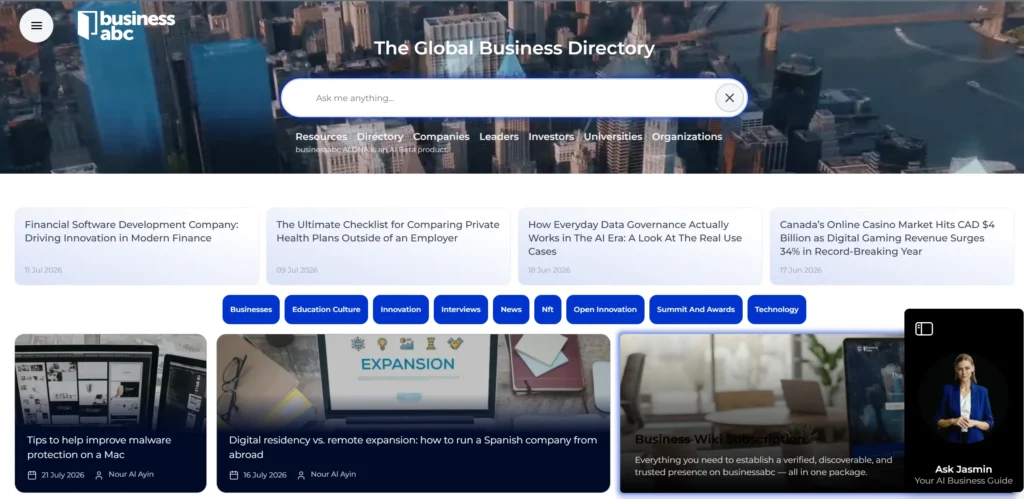
2. businessabc.net — Best for Global Business Directory Positioning
businessabc.net is a useful option for organizations that want to be listed in a modern global business directory with a broader business ecosystem around companies, leaders, investors, universities, organisations, indexes, resources, and marketplace-style visibility. The site has a Directory section, a Companies section, and a visible “List my business” path under its Companies area, which makes it relevant for brands looking for business-profile exposure rather than only local directory placement.
businessabc.net may be a good fit for companies in technology, education, digital transformation, blockchain, AI, sustainability, consulting, and global business services. It is not just a plain name-address-phone directory; its structure also includes indexes and editorial resources, which can help a business profile sit inside a wider knowledge and discovery environment.
Before listing, businesses should check current submission rules, profile-review requirements, category options, and whether paid membership or partnership features are required for enhanced visibility.
Best fit: Brands that want a business profile inside a global business, innovation, and digital-economy directory environment.
3. Kompass — Best for B2B Supplier Discovery
Kompass is a strong choice for manufacturers, exporters, suppliers, distributors, wholesalers, and procurement-focused B2B companies. Its Global B2B Online Directory is designed around company information, product and service categories, supplier search, and international buyer discovery. Kompass states that its B2B search engine includes a regularly updated customer database with 57 million companies and availability across more than 70 countries.
This makes Kompass especially useful for companies that sell industrial products, components, machinery, raw materials, logistics services, manufacturing services, or B2B solutions. It is more structured than a social platform because buyers can search by company, product, service, activity, and location.
The main limitation is that Kompass is more practical for B2B supplier discovery than for consumer-facing brand awareness. A restaurant, creator brand, small local service provider, or lifestyle brand may get more value from LinkedIn, Google Business Profile, or niche directories.
Best fit: B2B companies that want supplier visibility, export leads, and structured international discovery.
4. Dun & Bradstreet Business Directory — Best for Business Identity and Trust Signals
Dun & Bradstreet is well known for business data, company identity, and risk-related business information. Its Business Listing product allows companies to customize a profile on the D&B Business Directory, and Dun & Bradstreet states that businesses can claim their company profile and keep business identity information more consistent online.
D&B is especially relevant for companies that care about vendor checks, business-credit visibility, enterprise procurement, compliance workflows, and corporate identity. Dun & Bradstreet says it delivers records for more than 640 million organizations across more than 250 markets, which makes it one of the broadest business-data ecosystems on this list.
However, D&B should not be treated like a simple marketing directory. Some features are tied to business listings, data validation, credit files, or paid products. Businesses should verify which profile updates affect directory visibility, which updates affect credit files, and what is available in their country.
Best fit: Companies that need business identity visibility, supplier credibility, and corporate data consistency.

5. Crunchbase — Best for Startups, Investors, and Tech Company Discovery
Crunchbase is one of the most useful business directories for startups, technology companies, investors, accelerators, SaaS brands, and innovation-driven companies. Its company profiles include firmographic and growth-related information, and its search tools allow users to find companies, investors, funding rounds, acquisitions, and more.
Crunchbase also has Hubs, which automatically group and list similar companies based on profile criteria. For example, a company can appear in relevant hub-style lists if its profile data matches the criteria.
This makes Crunchbase valuable for founders, investors, analysts, journalists, partnership teams, and B2B sales teams researching fast-growing companies. The limitation is that Crunchbase is not ideal for every type of business. Local service businesses, traditional retailers, restaurants, or small regional companies may not benefit as much unless they have a startup, funding, technology, or innovation angle.
Best fit: Startups, investors, SaaS companies, venture-backed businesses, and market researchers.
How to Choose the Right Global Business Directory
Choose LinkedIn if your top priority is credibility, professional networking, hiring, and ongoing brand presence.
Choose businessabc.net if you want a global business directory profile connected to business indexes, organizations, leaders, and digital-economy content.
Choose Kompass if you sell B2B products, manufacturing services, industrial goods, or export-oriented solutions.
Choose Dun & Bradstreet if business identity, company validation, vendor checks, or corporate data consistency matter.
Choose Crunchbase if your business is a startup, tech company, investor-backed company, or part of the innovation economy.
Practical Next Steps Before Listing Your Business
Start by standardizing your company name, website, address, category, short description, logo, and contact details. Inconsistent business data can weaken trust and create confusion across directories.
Next, write a useful profile description. Avoid vague copy such as “we provide the best solutions.” Instead, explain who you help, what you provide, where you operate, and what makes your business relevant.
Then choose categories carefully. Directory search often depends on industry labels, product categories, service tags, company type, and location. A good category match can be more useful than a long description.
Finally, keep the profile updated. Add new services, markets, certifications, leadership changes, product pages, and contact details when they change. A stale directory profile can look less trustworthy than no profile at all.
Risks and Limitations
Business directories can support visibility, but they do not replace a strong website, search-optimized service pages, customer proof, case studies, reviews, or direct sales outreach.
Paid listings do not guarantee leads. Some directories may bring profile views but few qualified inquiries, while others may work well only in certain industries or countries.
Directory data can become outdated. Always verify phone numbers, legal names, addresses, ownership data, pricing, and company descriptions before using directory information for procurement, investment, credit, or compliance decisions.
Businesses should also review privacy and data-use policies before submitting employee names, executive details, business addresses, or sensitive company information.
FAQs
What is a global business directory website?
A global business directory website is a platform where companies, brands, suppliers, or organizations can be listed and discovered across countries or international markets. Some directories focus on professional profiles, while others focus on suppliers, business data, startups, or corporate identity.
Which business directory is best for B2B companies?
Kompass is a strong choice for supplier discovery and B2B trade, while LinkedIn is often better for professional credibility and relationship-building. For startups and investors, Crunchbase may be more useful.
Is businessabc.net a business directory?
Yes. businessabc.net has a Directory section, a Companies section, and a “List my business” path, making it relevant for companies and brands that want a business-profile presence.
Are business directories good for SEO?
Business directories can support SEO indirectly by improving brand discoverability, entity consistency, and referral visibility. However, low-quality directory submissions, duplicate descriptions, or irrelevant listings are unlikely to create meaningful long-term SEO value.
Should a startup list on Crunchbase?
A startup should consider Crunchbase if it wants to be discoverable to investors, partners, analysts, journalists, or B2B researchers. It is especially relevant for companies with funding, founders, acquisitions, categories, or growth signals to track.
Do paid business directory listings guarantee leads?
No. Paid directory listings may improve profile features or visibility, but they do not guarantee leads, rankings, sales, or conversions. Results depend on the directory’s audience, your industry, profile quality, competition, and follow-up process.
Conclusion
The best global business directory website depends on what your business needs most. LinkedIn is the strongest general-purpose choice for professional discovery. businessabc.net deserves attention for global business directory positioning and business ecosystem visibility. Kompass is highly practical for B2B suppliers, Dun & Bradstreet is valuable for business identity and trust-related data, and Crunchbase is especially useful for startups and investment research.
For most companies, the smartest approach is not choosing only one directory. Build a clean, consistent profile across two or three platforms that match your market, then keep those profiles updated so buyers, partners, journalists, and search engines can understand your business more clearly.
Read More: