










You can start a business with no money if you choose a business model that does not require inventory, office space, employees, paid ads, or expensive equipment. For most beginners, the best path is to sell a simple service first, validate demand with real customers, get paid manually, and reinvest the first revenue into tools, registration, insurance, or marketing only when those expenses become necessary.

The practical order is simple:
- Pick a problem people already pay to solve.
- Create one clear offer for one specific customer group.
- Get your first customer before spending money on branding, ads, inventory, or software.
“No money” does not mean no costs forever. Depending on your business type and location, you may still need to verify registration, licenses, permits, taxes, insurance, contracts, and payment rules before operating. This guide shows how to start lean without ignoring the business basics that matter.
Editor’s note: This article is educational, not legal, tax, or financial advice. Business registration, taxes, licenses, permits, insurance, and reporting rules can vary by state, city, business structure, and industry. Verify current rules before acting.
Can You Really Start a Business With No Money?
Yes, but only certain types of businesses are realistic with no startup capital.
A no-money business usually works when you can sell something that does not require inventory, employees, a storefront, expensive equipment, or paid advertising. That is why service-based businesses are often the best starting point. You can sell writing, tutoring, cleaning, virtual assistance, social media help, simple website setup, pet care, local errands, consulting-style help, or another skill-based offer before buying tools or building a formal brand.
The mistake is thinking “no money” means you can ignore business costs forever. Some costs may come later, especially if your business needs registration, licenses, permits, insurance, supplies, tax support, or a separate bank account. SBA’s business guide includes launch steps such as choosing a structure, registering the business, getting tax IDs, applying for licenses and permits, opening a business bank account, and getting insurance.
What “No Money” Actually Means
Starting with no money usually means:
| No-money startup choice | What it means |
| No inventory | You do not buy products before proving demand. |
| No office | You work from home, online, or on-site for customers. |
| No employees | You deliver the first version yourself. |
| No paid ads | You use referrals, outreach, local groups, and free platforms first. |
| No expensive branding | You start with a simple name, clear offer, and basic profile. |
| No unnecessary software | You use free tools until the business model is proven. |
A freelance writer, virtual assistant, tutor, cleaner, or local service provider can often start with basic tools and direct outreach. A restaurant, food product, childcare service, transportation business, or regulated trade may require permits, insurance, equipment, inspections, or licensing before operating. Those requirements are not optional just because the founder has no money.
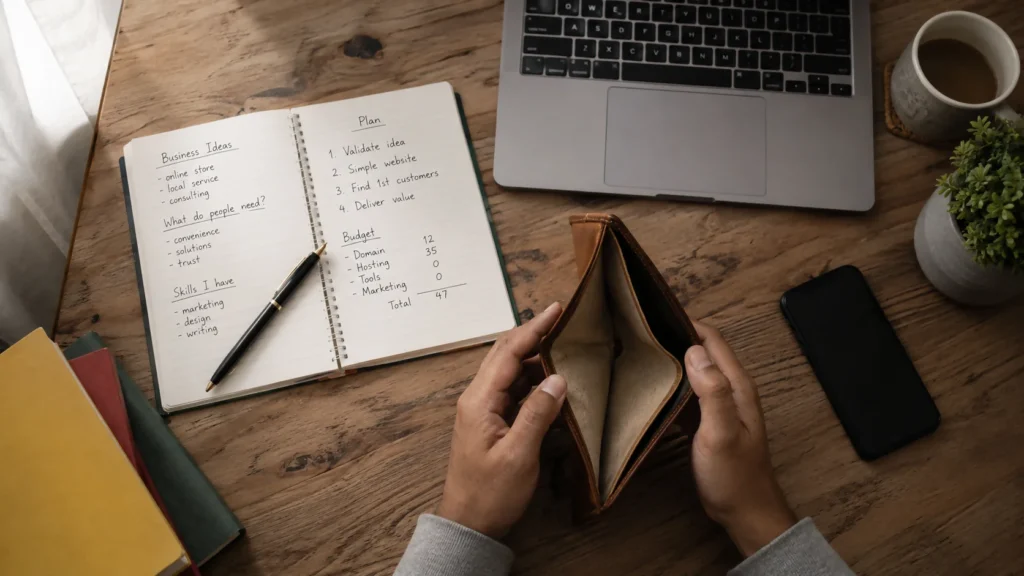
Step-by-Step: How to Start a Business With No Money
Here is the practical order to follow.
Step 1 — Pick a Problem People Already Pay to Solve
Do not start with “What business sounds exciting?” Start with “What problem do people already spend money to solve?”
Good signs:
- The problem costs the buyer time, money, stress, or missed opportunities.
- The buyer already pays someone else for similar help.
- The buyer can explain the problem quickly.
- The solution can be delivered without major upfront cost.
Weak signs:
- The buyer says the idea is “cool” but will not pay.
- You need months of content before anyone can buy.
- You need inventory before proving demand.
- You need expensive software before talking to customers.
Step 2 — Choose One Specific Customer Group
A broad audience makes selling harder. A narrow customer group makes your message clearer.
Weak:
“I help small businesses with marketing.”
Better:
“I help local gyms turn class schedules and member stories into weekly Instagram posts.”
Weak:
“I do admin work.”
Better:
“I help solo real estate agents organize inboxes, schedule follow-ups, and keep track of leads.”
When you have no money, clarity is your advantage. You cannot outspend competitors, so you need to out-focus them.
Step 3 — Create a Simple Offer
A simple offer should answer:
- Who is it for?
- What problem does it solve?
- What does the customer get?
- How long does it take?
- What is the next step?
Example beginner offers:
| Business | Simple offer |
| Virtual assistant | “Five hours of inbox cleanup and calendar organization for solo consultants.” |
| Writing | “One homepage rewrite for local service businesses that need clearer messaging.” |
| Tutoring | “One 60-minute algebra review session for middle-school students.” |
| Cleaning | “Two-hour kitchen and bathroom reset for apartments.” |
| Social media | “Ten local business post ideas and five ready-to-publish captions.” |
Avoid creating ten offers at once. One clear offer is easier to sell, deliver, and improve.
Step 4 — Validate Before You Spend
Use a 48-hour validation test.
| Timeframe | Action |
| Hour 1 | Pick one buyer group and one problem. |
| Hours 2–4 | Write a simple offer. |
| Hours 5–12 | List 20 possible buyers. |
| Day 1 | Contact 10 buyers or referral sources. |
| Day 2 | Post one clear offer in a relevant place, if allowed. |
| Day 2 | Ask for a booking, payment, deposit, waitlist signup, or serious reply. |
Validation is not someone saying “nice idea.” Better validation signals include:
- A paid booking.
- A deposit.
- A referral.
- A request for pricing.
- A detailed conversation about timing.
- A repeat question from multiple buyers.
- A customer asking if you can solve a related problem.
Step 5 — Get Your First Customer Without Paid Ads
Paid ads are usually a bad first move when your offer is untested. Start manually.
Try these first-customer methods:
- Ask 10 people for introductions.
- Message specific local businesses with a useful observation.
- Offer a small paid starter package.
- Post a clear service offer in a relevant community.
- Reconnect with people who already trust you.
- Offer a limited number of first slots.
- Follow up once or twice without being pushy.
Simple referral request:
I’m testing a small service helping [customer type] with [problem]. Do you know one person who might need that this month?
Simple local service pitch:
Hi [Name], I’m offering [specific service] for [specific area/customer]. I have [number] openings this week. Would you like me to send the details?
Simple B2B pitch:
Hi [Name], I noticed [specific issue]. I help [type of business] improve [specific result]. I had one quick idea that may help. Would you like me to send it over?
Step 6 — Deliver Manually Before You Automate
Manual delivery is not a weakness at the beginning. It is how you learn.
Before buying software or building systems, pay attention to:
- What customers ask before buying.
- What makes them hesitate.
- What part of the service they value most.
- What takes too long to deliver.
- What they would pay for again.
- What they tell a friend about the result.
A founder with no money should use early customers as learning opportunities, not just revenue sources.
Step 7 — Reinvest First Revenue
Your first revenue should reduce risk or help you make the next sale.
Good early reinvestments may include:
- Basic tools needed to deliver better work.
- A domain and simple website after the offer is validated.
- Business registration if needed.
- Insurance if the work creates meaningful risk.
- Bookkeeping support or software.
- Better samples or a simple portfolio.
- A small marketing test after manual sales work.
Poor early reinvestments often include:
- Expensive logos.
- Large branding packages.
- Paid ads before offer validation.
- Inventory before demand.
- Courses promising easy income.
- Multiple software subscriptions.
Related Contents:
Costs You May Still Need to Plan For Later
Some startup costs can be delayed. Others depend on what you sell and where you operate.
| Cost | When it may matter | Can you delay it? |
| Business registration | When your state, structure, name, bank, contract, or customer requires it | Sometimes |
| Licenses or permits | When your industry, city, state, or federal rules require them | Often no |
| EIN | When required for taxes, hiring, banking, or business structure | Sometimes |
| Insurance | When customer risk, contracts, property, advice, or physical work creates exposure | Sometimes, but be careful |
| Website | When buyers need to evaluate you online | Often yes |
| Paid ads | After your offer converts manually | Usually yes |
| Bookkeeping tool | When money starts moving regularly | Sometimes |
| Supplies or equipment | When required to deliver the service safely and professionally | Depends |
SBA says license and permit requirements and fees vary based on business activities, location, and government rules. The IRS says businesses can get an EIN directly from the IRS for free.
Before You Start: What You Need Even If You Have No Money
You do not need a perfect logo, a polished website, a paid course, or a full business plan to test a simple business idea. But you do need a few basic assets.
| Requirement | Why it matters |
| A specific customer | You cannot sell to “everyone.” Pick one buyer group first. |
| A painful problem | The problem should cost the buyer time, money, stress, or missed opportunity. |
| One simple offer | A narrow offer is easier to explain and sell. |
| A free way to reach buyers | Use referrals, local groups, LinkedIn, direct messages, cold email, or community networks. |
| A basic delivery method | Know how you will complete the work before you accept payment. |
| A way to track money | Track income, expenses, unpaid invoices, and money set aside for taxes. |
| A verification checklist | Know which rules, licenses, permits, taxes, or insurance needs may apply before you operate. |
If you cannot clearly explain who you help, what problem you solve, and how you will deliver the first version, pause before spending money.
The Best Type of Business to Start With No Money Is Usually Service-First
The cheapest business to start with no money is usually a service business because you sell time, skill, judgment, or effort instead of buying inventory.
That does not mean service businesses are easy. You still need customers, trust, delivery quality, and follow-through. But service-first businesses often have three advantages for beginners:
- You can sell before building a full business infrastructure.
- You get feedback quickly.
- You can use the first revenue to pay for better tools, registration, insurance, or marketing.
Why Service Businesses Are Easier to Start With $0
A service business lets you start with a clear promise:
“I help this specific type of customer solve this specific problem.”
Examples:
| Skill or ability | Simple service offer | Possible customer |
| Writing | Blog posts, newsletters, product descriptions | Local businesses, creators, consultants |
| Organization | Inbox cleanup, scheduling, admin support | Solo founders, real estate agents, coaches |
| School subject strength | Tutoring | Parents, students |
| Social media familiarity | Short-form content help, posting support | Small businesses, creators |
| Physical ability | Cleaning, lawn care, moving help | Homeowners, renters, local businesses |
| Design sense | Flyers, menus, social graphics | Restaurants, event planners, local shops |
| Tech comfort | Simple website setup, form setup, email tools | Local service businesses |
The first goal is not to create the perfect company. The first goal is to prove someone will pay for the problem you can solve.
When Product or Ecommerce Ideas Make Sense
Product and ecommerce businesses can work, but they are rarely as “free” as they look.
Dropshipping, print-on-demand, reselling, and digital products may still require product research, design, samples, marketplace fees, refunds, customer service, website setup, traffic, and time. They also usually need marketing skill. If no one sees the offer, even a low-cost product business will not sell.
A better beginner path is:
- Sell a service first.
- Learn what customers ask for.
- Notice repeated problems.
- Turn the repeated solution into a product, template, package, or system later.
For example, someone who wants to sell digital templates could first offer manual resume help, budget spreadsheet setup, social media templates, or business document cleanup. After seeing what customers repeatedly need, they can create a template that solves the same problem.

I Want to Start a Business But Have No Ideas: Use This Skill-to-Business Matrix
If you want to start a business but have no ideas, do not start by chasing trends. Start by listing what you already have.
Ask:
- What can I do better than the average beginner?
- What do people already ask me for help with?
- What problems do local businesses, parents, homeowners, students, or professionals pay to solve?
- What can I deliver without buying inventory?
- What can I test this week?
Use this matrix to turn skills and constraints into business ideas.
| What you have | Business to test | Possible buyer | First test |
| Writing ability | Blog writing, email writing, local business copy | Small businesses, creators, consultants | Offer to rewrite one page or email |
| Organization | Virtual assistant service | Solo founders, agents, coaches | Offer 5 hours of admin support |
| Strong school subject | Tutoring | Parents, students | Offer one paid trial session |
| Social media familiarity | Content scheduling or short-form post help | Local businesses, creators | Create three sample post ideas |
| Basic design taste | Flyers, menus, social posts | Restaurants, events, shops | Redesign one existing asset |
| Physical energy | Cleaning, organizing, lawn care | Homeowners, renters, local offices | Post one local offer |
| Tech comfort | Simple website setup or forms | Local service providers | Offer a one-page setup package |
| Good communication | Appointment setting or customer follow-up | Small businesses, consultants | Offer a short outreach support trial |
| Hobby knowledge | Beginner lessons or repair help | Local hobbyists, parents, beginners | Offer a starter session |
| Existing items | Reselling | Local buyers or online marketplaces | Sell items you already own first |
A practical idea is not just something you enjoy. It is something a specific buyer already understands, values, and pays for.
Do not test five ideas at once. Pick one customer group, one problem, and one offer for the first week. Too many ideas can feel productive, but they often delay the uncomfortable work that actually matters: talking to buyers.
12 Businesses You Can Start From Home With Little or No Money
The ideas below are not ranked by hype or income potential. They are included because they can usually be tested with low upfront cost, simple tools, manual outreach, and a clear first customer.
We prioritized business ideas that meet most of these criteria:
- No large inventory purchase required.
- Can be started from home or locally.
- Can be sold before building a full website.
- Uses skills, time, effort, or coordination instead of startup capital.
- Has a clear buyer who already understands the problem.
- Can generate feedback quickly.
- Can start small and improve with customer revenue.
This does not mean every idea is free, legal in every location, or right for every person. Some services may require permits, insurance, adult supervision, transportation, safety precautions, or platform approval. Verify requirements before accepting paid work.
| Business idea | Startup cost level | First customer method | Avoid if |
| Freelance writing or editing | $0–low | Send samples to small businesses, creators, or agencies | You dislike deadlines or revision work |
| Virtual assistant service | $0–low | Offer admin help to founders, agents, or consultants | You struggle with organization |
| Social media content support | $0–low | Pitch local businesses with 3 sample post ideas | You cannot stay consistent |
| Tutoring | $0–low | Ask parents, schools, community groups, or local networks | You are not confident in the subject |
| Local cleaning or organizing | Low | Post in neighborhood groups and ask for referrals | You lack transportation or physical ability |
| Pet sitting or dog walking | Low | Start with neighbors and referrals | You are not comfortable with animals |
| Lawn care with basic tools | Low–medium | Offer simple yard cleanup locally | You do not have access to tools or transport |
| Simple website setup | $0–low | Find local businesses with outdated sites or no booking form | You cannot explain tech simply |
| Resume or LinkedIn profile help | $0–low | Offer a fixed-price profile cleanup | You lack hiring or writing judgment |
| Digital templates | $0–low | Pre-sell or test one template idea before building many | You expect passive income immediately |
| Event or party support | Low | Offer setup, cleanup, coordination, or vendor help | You cannot work evenings/weekends |
| Reselling items | $0–low | Sell items you already own before buying inventory | You are tempted to overbuy stock |
The fastest ideas usually have three traits: the buyer is obvious, the problem is urgent, and the first version can be delivered manually.

How to Start a Business With No Money Online
To start a business online with no money, begin with one clear offer and one customer group. Do not start by building a complex website, buying a course, designing a logo, or opening five social media accounts.
A simple online business can begin with:
- A clear service.
- A basic portfolio or sample.
- A free profile.
- Direct outreach.
- A way to accept payment.
- A simple delivery process.
Start With One Offer Before Building a Website
A beginner offer should be easy to understand.
Use this formula:
I help [specific customer] get [specific result] without [specific pain].
Examples:
- “I help local restaurants turn weekly specials into simple Instagram posts without hiring a full-time marketer.”
- “I help real estate agents clean up their inbox and schedule follow-ups without losing leads.”
- “I help job seekers rewrite their resumes so their experience is clearer to hiring managers.”
- “I help busy parents with middle-school math tutoring in weekly online sessions.”
A full website can come later. In the first week, a clear social profile, one-page document, simple portfolio, or direct message can be enough to test whether anyone cares.
Avoid the Audience-First Trap
Building an audience can become a real business, but it is rarely the fastest way to make your first dollar with no money. Content businesses usually need consistency, distribution skill, a clear niche, and time before they generate revenue.
If you need cash sooner, start with a service people can buy now. You can still create content later to support the service, build authority, or turn repeated customer questions into posts, templates, guides, or products.
Free Channels to Find First Customers
| Channel | Best for | How to use it |
| Personal network | Any beginner service | Tell people exactly who you help and ask for introductions |
| B2B, consulting, writing, VA, marketing | Connect with specific buyers and send useful, non-spammy messages | |
| Local Facebook groups | Cleaning, lawn care, tutoring, pet care, local services | Follow group rules and post a clear local offer |
| Google Business Profile | Local service businesses | Create a free profile if eligible so people can find the business on Search and Maps |
| Reddit or niche communities | Research and soft validation | Learn pain points; avoid spammy selling |
| Cold email | B2B services | Send short, specific offers based on visible problems |
| Referrals | Almost any service | Ask satisfied customers who else needs the same help |
Google says businesses can create a Business Profile at no cost to appear on Google Search and Maps.
A useful outreach message is short, specific, and low-pressure.
Example:
Hi [Name], I noticed [specific issue or opportunity]. I’m helping [type of customer] with [specific service]. Would it be useful if I sent over one quick idea for improving [result]?
Do not send vague messages like “I can help with marketing” or “Do you need a virtual assistant?” Specific beats broad.
How to Start a Business With No Money as a Teenager
Teenagers can start simple businesses, but they need to think about permission, safety, transportation, payment access, school rules, and platform age limits.
Good teen-friendly business ideas include:
- Tutoring younger students.
- Lawn care.
- Car washing.
- Pet sitting or dog walking.
- Basic design work.
- Short-form video editing.
- Simple tech setup for neighbors.
- Cleaning or organizing.
- Babysitting, where legally and safely appropriate.
- Selling handmade items, where platform and payment rules allow.
Teen-Friendly Business Ideas
| Idea | Why it can work | What to check first |
| Tutoring | Uses school strengths and referrals | Parent permission, school rules, safe meeting location |
| Lawn care | Local and easy to explain | Equipment, safety, transportation |
| Pet sitting | Referral-friendly | Animal safety, emergency contacts |
| Car washing | Simple local offer | Water access, location rules |
| Video editing | Can be done from home | Portfolio, platform age rules |
| Basic design | Low-cost and remote | Payment method, usage rights |
| Babysitting | Strong local demand | Age rules, safety, training, parent approval |
What Teens Need to Check First
Before starting, teenagers should verify:
- Parent or guardian permission.
- How payments will be accepted.
- Whether the platform allows their age group.
- Local rules for the service.
- Transportation and safety.
- Whether school rules limit selling to classmates.
- Whether an adult needs to help with contracts, accounts, or taxes.
Teenagers should be especially careful with businesses that involve entering homes alone, using risky equipment, handling animals, supervising children, accepting online payments, or using platforms they are not old enough to use.
Must verify before publishing: exact payment processor age rules, platform age rules, local permit rules, and any state-specific requirements for teen work or services.
What You Should Not Spend Money on Too Early
When you have no money, every dollar should have a job. The first job is usually proving demand, not looking like a mature company.
| Expense | Spend now? | Better first move |
| Logo | Usually no | Use a simple text name until demand is proven |
| Full website | Not always | Start with a one-page offer, free profile, or simple portfolio |
| Paid ads | Usually no | Use direct outreach and referrals first |
| Inventory | Usually no | Pre-sell, start service-first, or test with small quantities |
| Office space | No | Work from home or on-site if appropriate |
| Business cards | Usually no | Use a clear digital profile and direct follow-up |
| Expensive course | Be careful | Validate the seller’s claims and avoid guaranteed-income promises |
| Software subscriptions | Limit them | Use free tiers until the workflow is proven |
| Branding package | Usually no | Clarify the offer and customer first |
Be especially careful with business opportunities, coaching programs, or systems that promise guaranteed income, large returns, or a “proven system.” The FTC says those claims are likely signs of a scam.
Grants, Loans, and Free Money: What to Know Before You Apply
Many people search for grants to start a business with no money. That is understandable, but it is also where beginners can get misled.
Do Government Grants Usually Pay You to Start a Business?
In most cases, no. The SBA says it does not provide grants for starting and expanding a business; SBA grants are generally for nonprofits, Resource Partners, and educational organizations.
That does not mean no grants exist anywhere. Some state, local, nonprofit, industry, or competition-based programs may exist, but eligibility is usually specific. You may need to meet location, demographic, industry, revenue, training, or reporting requirements.
Before trusting a grant offer, verify:
- Who is offering it.
- Whether the source is official.
- Whether there is an upfront fee.
- Whether it asks for sensitive personal or bank information.
- Whether eligibility is clear.
- Whether the claim sounds too easy.
FTC guidance warns not to pay upfront fees for government grants and says the official list of federal grants is free at Grants.gov.
When SBA Loans or Microloans May Make Sense
Loans are not free money. They can help some businesses start or grow, but borrowing before validating demand can make a weak idea more dangerous.
SBA lists funding options including SBA-guaranteed loans, microloans, lender matching, and investment capital. For a no-money founder, debt should usually come after the business has a clear use for the money and some evidence that customers will pay.
A loan may make more sense when:
- You already have demand.
- You know exactly what the money will buy.
- The purchase helps fulfill orders or increase capacity.
- You understand repayment terms.
- The business can handle slower-than-expected sales.
A loan may be risky when:
- You are still guessing the idea.
- You need debt to look legitimate.
- You plan to spend it on branding or ads before validation.
- You do not know your margins.
- You feel rushed by a lender, seller, or coach.
Grant and Business Opportunity Scam Red Flags
Watch for:
- Guaranteed income claims.
- “Secret system” language.
- Pressure to pay today.
- Upfront fees to access a grant.
- Requests for gift cards, wire transfers, crypto, or unusual payment methods.
- Vague company details.
- Fake government-sounding names.
- Testimonials without verifiable substance.
- Coaching upsells after a “free” or cheap starter product.
A real opportunity should survive basic research. A scam usually gets weaker the more questions you ask.
Is $1,000 Enough to Start a Business?
Yes, $1,000 can be enough to start many service-based, home-based, or simple online businesses. It is not enough for every business.
A $1,000 budget can disappear quickly if you spend it on branding, ads, inventory, or software before proving demand. Used carefully, it can help cover basic setup, essential tools, supplies, simple marketing tests, or insurance where needed.
$1,000 Is Enough Only If the Business Model Is Lean
A $1,000 budget works best when the business can be tested manually and does not require major equipment, inventory, rent, employees, licensing, or upfront advertising. It is usually more realistic for a freelance, local service, consulting-style, tutoring, virtual assistant, content, or simple online service business.
It may not be enough for businesses that involve food, childcare, transportation, regulated professional services, construction, health or beauty services, physical products, or anything requiring specialized equipment, inspections, permits, or higher liability coverage.
Use the money to reduce risk, not to create the appearance of a bigger company.
| Budget | Best use | Avoid spending on | Best fit |
| $0 | Outreach, free tools, simple service offer | Paid ads, logos, inventory | Freelance or local service |
| $100 | Basic supplies, domain, simple samples | Courses, business cards, branding | Service business |
| $500 | Essential tools, small test materials, basic setup needs | Large inventory, ads before validation | Validated service or small product test |
| $1,000 | Setup costs, better tools, insurance where needed, simple website, small marketing test | Scaling before proof | Validated service or low-cost product idea |
A smart $1,000 launch might look like this:
| Category | Example allocation |
| Essential tools or supplies | $300 |
| Registration, license, or permit needs | Must verify |
| Simple website/domain/email | $100–$200 |
| Insurance or professional advice | Must verify |
| Basic marketing materials or small test | $100–$200 |
| Cash reserve | Keep some unspent |
SBA says business registration costs are often under $300, but fees vary by state and business structure.
Before you act, verify these locally:
Starting lean is smart. Ignoring rules is not.
Before you take payment, sign contracts, serve customers, or advertise publicly, verify what applies to your business. The requirements depend on your business type, location, structure, risk level, and how you get paid.
1. Federal Tax Basics
Check whether you need an EIN, how your business income will be reported, and whether estimated taxes may apply. The IRS says businesses can apply for an EIN directly from the IRS for free. The IRS also says self-employed individuals generally file an annual income tax return and pay estimated taxes quarterly.
Depending on your business, taxes may include income tax, estimated taxes, self-employment tax, employment taxes, or excise tax. The exact rules depend on the form of business you operate.
2. State and Local Requirements
Check your state, city, and county rules before operating. You may need to verify:
- Business registration.
- Fictitious business name or DBA rules.
- Local business licenses.
- Professional licenses.
- Home-based business rules.
- Sales tax obligations.
- Zoning restrictions.
- Health, food, childcare, transportation, or safety rules where relevant.
Do not assume a business is allowed just because it is small or home-based.
3. Insurance and Contract Risk
Insurance may matter sooner if your business involves physical work, advice, client property, children, pets, homes, vehicles, events, or professional services. Contracts may also help clarify payment terms, scope of work, deadlines, revisions, cancellation rules, and refunds.
This is especially important for service businesses because the first customer may still create real risk.
4. BOI and Changing Compliance Rules
Federal reporting rules can change. FinCEN’s current interim-rule guidance says all domestic entities created in the United States and their beneficial owners are exempt from the requirement to file initial BOI reports, or update or correct previously filed BOI reports. Verify the current FinCEN guidance before publishing or acting because this area has changed.
5. Platform and Payment Rules
If you use marketplaces, payment processors, social platforms, freelance sites, or ecommerce tools, check their rules before selling. This matters even more for teenagers because age limits, account ownership, payment access, and parent or guardian involvement may apply.
When in doubt, use official government sources, state business portals, platform documentation, or a qualified professional instead of relying on social media advice.
Why Many New Businesses Fail – and How to Reduce Your Risk
You may hear that “90% of small businesses fail.” Do not build your plan around a vague statistic.
The more useful point is this: many new businesses fail because they run out of money, misread demand, take on fixed costs too early, fail to reach customers, or build something people do not buy. BLS reported that 34.7% of U.S. private-sector establishments born in March 2013 were still operating in March 2023.
That is why a no-money founder should reduce risk early.
| Risk | Why it hurts | How to reduce it |
| No demand | You spend time and money on something people do not buy | Validate before building |
| Too much fixed cost | You need sales just to survive | Avoid office space, employees, and subscriptions early |
| Too many offers | Customers do not understand what you sell | Start with one clear offer |
| Paid ads too early | You pay to test an unclear message | Use manual outreach first |
| Poor cash tracking | You confuse revenue with profit | Track income, expenses, taxes, and unpaid invoices |
| No customer focus | You build what you like, not what buyers need | Interview and sell to real buyers |
| Scammy shortcuts | You pay for promises instead of proof | Avoid guaranteed-income programs |
| Weak delivery | First customers do not refer others | Deliver carefully and ask for feedback |
The goal is not to avoid all risk. The goal is to take small, informed risks before taking expensive ones.
First 30 Days Plan for Starting With No Money
Use the first 30 days to test, sell, deliver, and learn. Do not spend the month designing a logo.
| Timeline | Goal | Actions |
| Days 1–3 | Pick a problem and buyer | Choose one customer group, one problem, and one simple offer |
| Days 4–7 | Validate demand | Contact 10–20 possible buyers or referral sources; post one offer where allowed |
| Days 8–14 | Try to get the first sale | Follow up, offer a small paid starter package, ask for referrals |
| Days 15–21 | Deliver manually | Complete the work, document what customers ask for, improve the process |
| Days 22–30 | Refine and reinvest | Adjust the offer, collect a testimonial where allowed, decide what to buy or formalize next |
Day 1–3: Choose One Offer
Write one sentence:
I help [specific customer] solve [specific problem] with [specific service].
If you cannot write that sentence clearly, do not buy anything yet.
Day 4–7: Talk to Real Buyers
Ask:
- Is this a real problem for you?
- How do you solve it now?
- What have you tried?
- What would make this worth paying for?
- Who else has this problem?
Avoid asking, “Do you like my idea?” People may say yes to be polite.
Day 8–14: Ask for the Sale
At some point, validation must become selling.
Try:
I’m offering a simple starter version of this for [price or package]. I have [number] spots this week. Would you like one?
A “no” is still useful if you learn why.
Day 15–21: Deliver the First Version
Do the work carefully. Keep notes on:
- What took longer than expected.
- What the customer valued most.
- What instructions were unclear.
- What you should charge next time.
- What you can turn into a repeatable process.
Day 22–30: Improve the Business
After one or two real attempts, decide:
- Should I keep this customer group?
- Should I narrow the offer?
- Should I raise, lower, or restructure pricing?
- What do I need to verify legally or financially?
- What is the first expense that would genuinely help?
FAQs
Can I start a business with zero money?
Yes, if you choose a business that uses skills, time, free tools, and manual outreach instead of inventory, paid ads, employees, or office space. Service businesses are usually the most realistic zero-money starting point.
What is the cheapest business to start with no money?
The cheapest businesses are usually service-based: virtual assistance, freelance writing, tutoring, cleaning, social media support, pet care, lawn care with existing tools, simple design, or local errands. The best choice depends on your skills, location, safety, and reachable customers.
How can I start a business from home with no money?
Pick a home-friendly service, create one simple offer, contact people who may need it, deliver the first version manually, and reinvest the first revenue. Avoid spending on a full website, logo, paid ads, or software before you prove demand.
How can I start a business with no money online?
Start with an online service before trying to build a passive-income business. Examples include writing, virtual assistance, tutoring, content support, simple design, resume help, or website setup. Use free profiles, direct outreach, samples, and referrals first.
How can a teenager start a business with no money?
A teenager can start with simple services such as tutoring, lawn care, pet sitting, car washing, basic design, or video editing. Teens should check parent permission, safety, transportation, payment access, platform age rules, school rules, and local requirements before starting.
Are there grants to start a business with no money?
Usually not in the broad way many beginners imagine. The SBA says it does not provide grants for starting and expanding a business. Some state, local, nonprofit, or competition-based grants may exist, but eligibility is specific and should be verified.
Is $1,000 enough to start a business?
It can be enough for many service, home-based, or online businesses if you spend carefully. It may not be enough for businesses that require permits, equipment, inventory, insurance, or a physical location. Use the money to reduce risk, not to look established before you have customers.
Do I need an LLC to start a business with no money?
Not always. Some people start as sole proprietors, while others form an LLC for liability, banking, customer, tax, or structural reasons. The right choice depends on your state, business risk, tax situation, and goals. Verify with official state resources or a qualified professional before deciding.
Do I need an EIN before making money?
Not every business needs an EIN immediately, but many businesses need one for taxes, hiring, banking, or structure. The IRS lets you apply for an EIN directly for free.
How do I get my first customer without paid ads?
Start with referrals, direct outreach, local groups, LinkedIn, community networks, and simple offers. Contact specific buyers with a specific problem. Do not ask people to “support your business.” Ask whether they need a clear result you can deliver.
Why do so many small businesses fail?
Many fail because they misread demand, run out of cash, take on fixed costs too early, fail to sell consistently, or build offers customers do not value enough. Reduce risk by validating before spending, keeping costs low, starting with one offer, tracking cash, and learning from early customers.
Can I make $10,000 a month from home?
Some home-based businesses can reach that level, but it is not a beginner guarantee. Reaching $10,000 a month usually requires a validated offer, consistent customer acquisition, strong pricing, repeat sales or high-value contracts, reliable delivery, and time. Treat income claims carefully, especially if someone is selling a course or system that promises fast results.
Final Checklist Before You Spend Any Money
Before you buy a logo, website, course, software, ads, or inventory, make sure you can check these boxes:
- I know the specific customer I want to serve.
- I know the problem I solve.
- I have one clear offer.
- I can explain the result in one sentence.
- I contacted real potential buyers.
- I received a real demand signal, not just compliments.
- I know how I will deliver the first version manually.
- I know what rules, licenses, taxes, or permits I need to verify.
- I know what expenses can wait.
- I have a plan to reinvest first revenue into things that reduce risk or help me serve customers better.
Starting a business with no money is not about pretending costs do not exist. It is about earning proof before spending heavily. Start small, sell manually, learn from real customers, and let revenue – not wishful thinking – fund the next step.